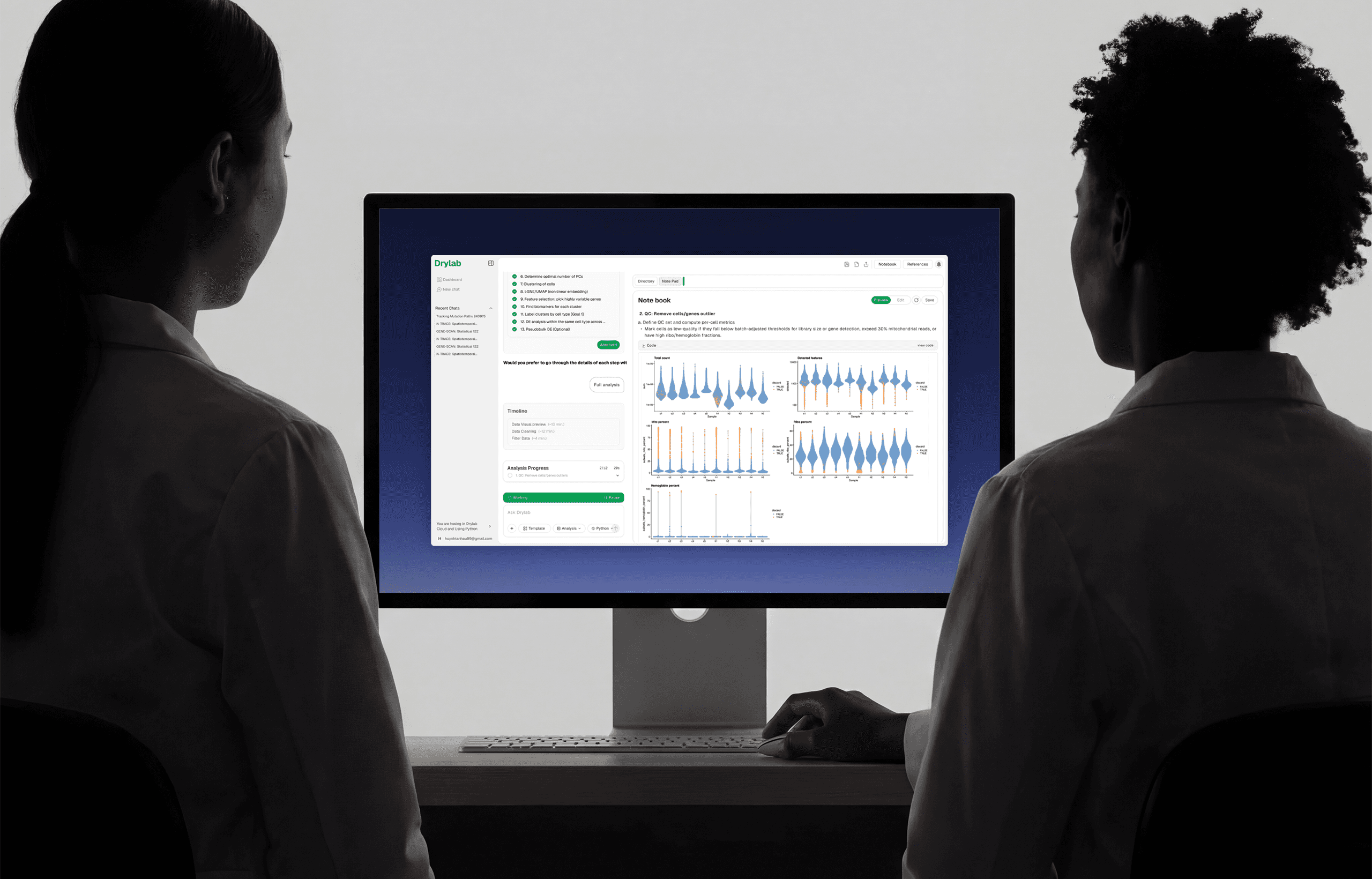
Built for world's leading life science teams

Verify hypothesis given all biomedical datasets in the world plus yours

1

Connect every source

Point Drylab at your data — published omics, your own lab lake, literature and protocols. We index it all into one versioned workspace your agents can reason over.

Import your lab data

Syncing lab data context across scatter scientific instruments, cloud storages, lab record, notebooks.

2

3

Define research objective

Gathering evidences across all known datasets to verify a hypothesis.

Run the swarm

Hundreds of agents explore in parallel, each in its own sandbox — running, verifying, resolving conflicts and merging the winners into one answer.

4

Real scientific questions, answered by Drylab AI agents

Discover disease-driving cell states, compare treatment response, identify biomarkers, map tissue microenvironments, and turn complex omics and imaging data into publication-ready evidence.
Tile
TileTileTileTileTileTileTileTileTileTileTileTileTile

Infrastructure is needed.

The scale of data, compute, and agents will explode the cost of every scientific endeavour. We've built what that future needs: the infrastructure for autonomous AI agents in scientific discovery.
Making workflow analysis 20× faster by optimizing kernels

We rewrote the single cell and spatial methods our agents depend on for GPUs, plus fast CPU and Rust ports, each checked against the original tool and served through one API. A full lung cancer run on 24,161 malignant cells drops from hours to minutes.

72

methods benchmarked

6.3 h → 19 min

Full LuCA atlas analysis pipeline run

723×

top method speedup

A swarm of agents, defeating 391 teams of scientists in developing the best ADMET AI model.

Everything your lab needs,
in one platform.

Web app
The autonomous dry lab. Driven by field experts' selected workflows
Deploy Drylab's analysis, research, and design agents to your teams right in the browser. A persistent notebook, terminal, and secure data vault, with no engineering lift.

Co-created data analysis.


Human-in-the-loop review gates.


Data platform introduction


Drylab API & MCP
An analysis & compute layer for the systems you build
Integrate Drylab's 200+ accelerated tools directly into your agentic systems and pipelines.

Programmatic runs via API.


MCP integration.


Batch processing.


Drylab API & MCP
An analysis & compute layer for the systems you build
Integrate Drylab's 200+ accelerated tools directly into your agentic systems and pipelines.

Programmatic runs via API.


MCP integration.


Batch processing.


Data concern?
Use Drylab based on your requirements.

Web App

for a quick trial & lean tear

Forward Deveployment

Workstation

Start in the browser

Sign in at app.thedrylab.com and try analysis with 1,000,000 omics datasets right away. Verify your hypothesis against all related published results.
— Directly try and see early results in a few minutes.
— Export the entire analysis trace into a reproducible capsule to share with colleagues or publish.
— Free Al tokens with abundant computing power for heavy omics analysis.

Web App

Forward Deveployment

Workstation

Start in the browser

Sign in at app.thedrylab.com and try analysis with 1,000,000 omics datasets right away. Verify your hypothesis against all related published results.
— Directly try and see early results in a few minutes.
— Export the entire analysis trace into a reproducible capsule to share with colleagues or publish.
— Free Al tokens with abundant computing power for heavy omics analysis.

Build the intelligence your next experiment will depend on.

Science is ready for a leap forward. Join us and make it happen.

Scientific work
Scientists
Discovery run
Team
Organisation

Discover disease-driving cell states, compare treatment response, identify biomarkers, map tissue microenvironments, and turn complex omics and imaging data into publication-ready evidence.